
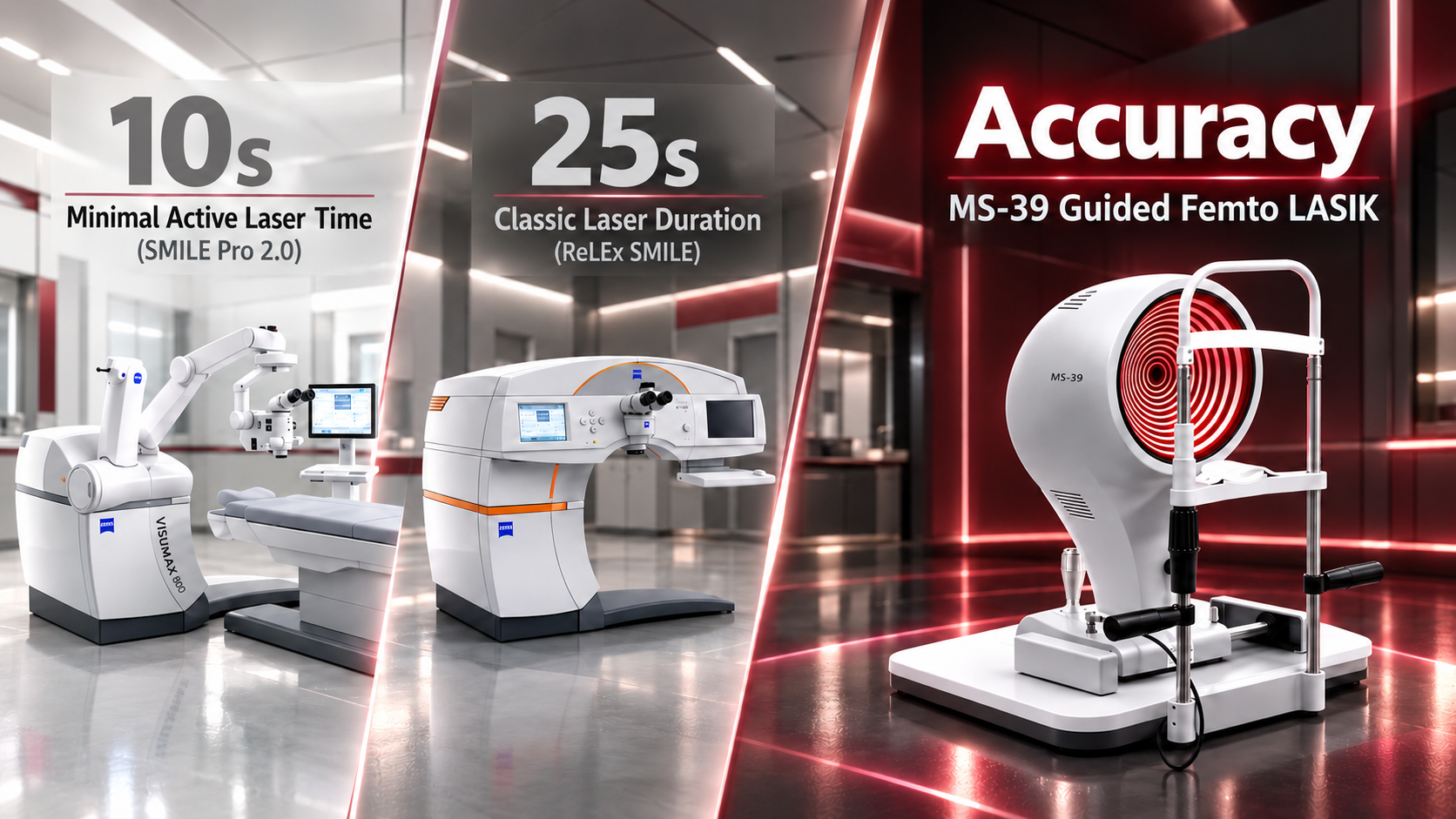
Faster doesn’t always mean better for your eyes. SMILE Pro eye surgery uses a 2 MHz laser to complete treatment in under 10 seconds, and reviews often highlight that speed. But for glasses removal, MS-39 Guided Femto-LASIK is the more advanced and accurate option.
Medically reviewed by: Babar Sana, Chief Optometrist at Amanat Eye Hospital.
Last Updated: October 2026
Speed Track vs. Customization Track
If you want to get rid of your glasses, laser eye surgery now offers two different advantages. One is a faster laser. The other is a treatment planned around your cornea.
What is SMILE eye surgery?
SMILE (Small Incision Lenticule Extraction), the speed track, is a flapless, keyhole procedure for glasses removal. Standard SMILE, performed using the ZEISS VisuMax 500, takes approximately 30 seconds of laser treatment per eye. SMILE Pro uses the newer VisuMax 800, which completes the laser treatment in less than 10 seconds per eye, thanks to its higher laser repetition rate.
Is SMILE Pro Worth It?
For patients with a regular cornea and a standard prescription, yes. SMILE eye surgery reviews often praise the quick visual recovery and the comfort of the short procedure.
But reviews only tell part of the story. If you have irregularities in your cornea, or you want a treatment planned around the exact shape of your eye, MS-39 Guided Femto-LASIK is worth considering too.
What is MS-39 Guided Femto-LASIK?
MS-39 Guided Femto-LASIK, the customization track, is a bladeless procedure for glasses removal. It starts with a detailed map of your cornea from the SCHWIND MS-39 OCT and topographer. That map guides the SCHWIND AMARIS® Special 1050RS Limited Edition laser, so the treatment is planned around your eye.
Is MS-39 Guided Femto-LASIK Worth It?
For patients who want a treatment planned around their own cornea, yes. It is among the latest laser vision correction technology in 2026, and it fits eyes that a standard treatment pattern may not suit, such as those who have cornea with irregularities or higher-order aberrations.
It is also not the right choice for everyone. If your cornea is regular and your prescription is standard, SMILE or SMILE Pro may serve you equally well.
This premium comparison of laser eye surgery options looks at both tracks, but only a proper eye assessment shows which track suits your eyes.
The Structural Benefits of Standard ReLEx SMILE Eye Surgery
At Amanat Eye Hospital, we perform ReLEx SMILE, a well-established procedure for correcting vision without creating a corneal flap. It is a proven option for patients looking for SMILE eye surgery.
Why Choose Standard SMILE?
SMILE offers several structural benefits:
- Bowman’s Membrane Protection: SMILE removes a small piece of corneal tissue from deeper layers while leaving the front 100–120 microns of the corneal stroma and Bowman’s membrane intact.
- Sub-Basal Nerve Preservation: Its small 2–4 mm incision helps preserve over 80% of the sub-basal corneal nerve plexus. This may reduce the risk and duration of temporary dry eye symptoms after surgery.
- Corneal Strength: By avoiding a corneal flap, SMILE preserves more of the cornea’s natural structure. Mathematical modelling suggests that the treated cornea may retain 10–15% greater tensile strength compared with traditional flapped LASIK. This helps maintain the cornea’s natural structural stability after surgery.
- Visual Recovery: Vision begins to improve soon after surgery. Around 85–90% of patients may achieve 20/20 vision without glasses within the first 24 hours.
These features contribute to the flapless laser eye surgery safety benefits of SMILE.
A Small Incision, No Corneal Flap
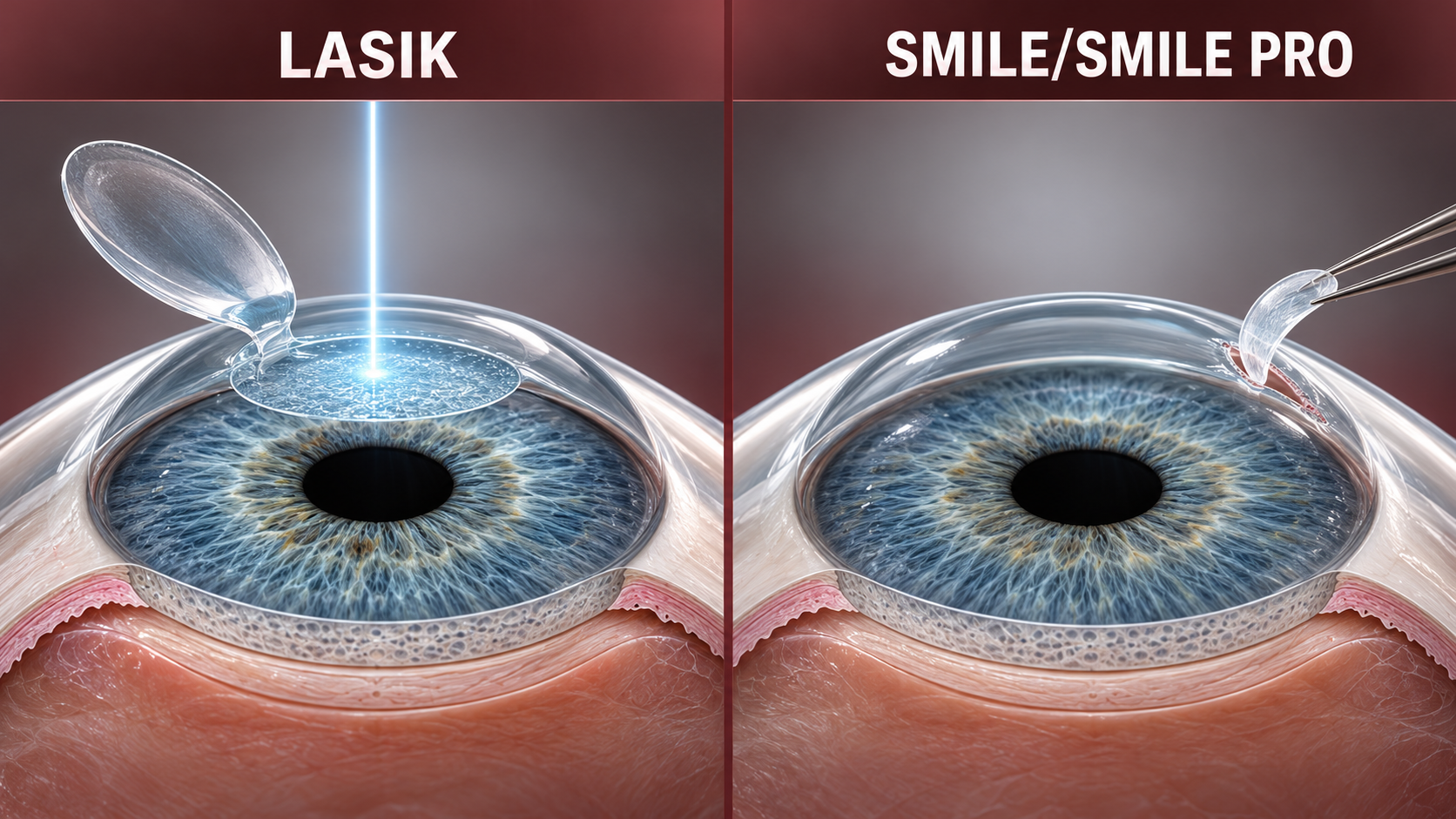
SMILE uses micro-incision lenticule extraction, removing a tiny piece of corneal tissue through a small opening of approximately 2–4 mm.
Is SMILE Pro Worth the Extra Cost?
For patients with a standard cornea and prescription, ReLEx SMILE can offer comparable visual results, safety and recovery to SMILE Pro. The main difference is that SMILE Pro completes the laser treatment faster.
That is a real difference, but it does not necessarily mean better vision. If standard SMILE is suitable for your eyes, paying a much higher price just for a faster laser may not be necessary.
The Technological Gap: Why Laser Speed Does Not Equal Visual Sharpness
SMILE Pro makes laser treatment faster, but faster treatment does not automatically mean sharper vision. Both SMILE and SMILE Pro correct common vision problems, but the way treatment is planned is just as important as the speed of the laser.
What Does Standard SMILE Treatment Correct?
Both procedures correct short-sightedness and astigmatism, also known as spherocylindrical errors. However, there are spherocylindrical treatment limits because the treatment is calculated from your glasses prescription using standard mathematical models. Automated centration assists in helping position the treatment, which follows a planned correction pattern.
What About the Shape of Your Cornea?
Your glasses prescription does not show every detail of your cornea. Standard treatment corrects lower-order aberrations, such as short-sightedness and astigmatism, but does not map every small variation in the corneal surface, such as uneven elevations or tiny dips.
These finer irregularities are known as higher-order aberrations (HOAs). They can affect visual quality, particularly in low-light conditions and at night.
Standard Treatment vs. Customized Mapping
This is where standardized laser eye surgery profiles vs. customized mapping become important. Customized mapping uses detailed measurements of your own cornea to help plan treatment around its individual shape and surface.
What Does SMILE Pro Eye Surgery Cost Cover?
The SMILE Pro eye surgery cost reflects newer laser technology and faster treatment. The higher price covers a faster laser, not necessarily a more precise prescription or a customized treatment plan.
The technology that makes customized corneal mapping possible is the MS-39 platform, which we’ll look at next.
The Premium Mapping Revolution
At Amanat Eye Hospital, MS-39 Guided Femto-LASIK combines detailed corneal mapping with advanced laser technology to plan customized glasses-removal treatment.
The MS-39 anterior segment OCT is not a laser. It is a high-resolution scanning device that examines your cornea and provides detailed information for treatment planning.
What Does the MS-39 Scan?
The scanner creates a 3D map of your cornea, capturing micron-level corneal layer data, including epithelial thickness mapping.
It also uses high-resolution Placido topography mapping to measure the curve of the cornea’s front surface. Placido rings project a pattern onto the cornea to measure its shape.
SD-OCT (spectral-domain optical coherence tomography) uses light to create detailed images of the corneal layers.
How Is the Procedure Performed?
- Mapping: The SCHWIND MS-39 scans your eye and creates a detailed corneal map.
- Flap Creation: A Ziemer femtosecond laser (FEMTO LDV Z8 or FEMTO Z8 NEO) creates a thin corneal flap without using a blade.
- Treatment Planning: The corneal map guides the SCHWIND AMARIS 1050RS ablation profile.
- Laser Treatment: The AMARIS excimer laser reshapes the cornea through point-by-point laser spot firing, following a treatment profile guided by the eye’s corneal topography and tomography data.
- The Result: This procedure is called MS-39 Guided Femto-LASIK, also known as corneal topography- and tomography-guided LASIK.
What Does This Mean for Your Vision?
Treatment Based on Your Cornea
Unlike standard prescription-based correction, MS-39 mapping identifies small variations in your corneal shape, including uneven elevations.
A Customized Treatment Plan
The laser uses this information to address your prescription and the mapped corneal irregularities. This may help light focus more crisply, including when looking at lights at night.
The same scan also helps doctors assess your corneal health and suitability for surgery.
Book MS-39 Guided Femto LASIK Assessment
Clinical Integrity: Advanced Screening for Laser Eye Surgery Candidacy
Before any laser eye surgery, your eyes must be checked to make sure the procedure is safe for you. At Amanat Eye Hospital, every patient seeking glasses removal undergoes screening, whatever procedure they are considering. This helps assess their laser eye surgery candidacy.
Screening Before Every Procedure
Pentacam: This scanner takes detailed pictures of the front and back of your cornea and measures its thickness. It helps identify unusual corneal shapes and early signs of keratoconus.
Corvis® ST: This device measures how your cornea responds to a gentle puff of air. It helps doctors assess the cornea’s strength and identify signs of structural weakness.
Together, Pentacam and Corvis® ST support early keratoconus detection software by helping identify signs of a cornea that may be thinning or weakening.
An Additional Safety Check with MS-39
Patients choosing MS-39 Guided Femto-LASIK also receive an MS-39 scan. Its ectasia risk index mapping calculates an Ectasia Risk Index (ERI) score to help assess whether the cornea is suitable for Femto LASIK.
Ectasia is a condition in which the cornea becomes weak and starts to bulge outward.
Checking Corneal Thickness and Safety Limits
The full thickness of the cornea is measured to understand how much tissue is available for treatment. Doctors also perform residual stromal bed safety calculations to check that enough corneal tissue will remain after surgery.
Every eye has a minimum thickness that must be preserved to help keep the cornea stable. These limits are assessed before a procedure is recommended.
Why Does Screening Matter?
People searching for smile eye surgery gone wrong may come across complications linked to unsuitable candidates. Careful screening helps identify potential risks before surgery and reduces the chance of complications.
If the results show that a procedure is not suitable for your eyes, your doctor will explain why and discuss other options where appropriate.
Experience, Screening, and Medical Review
- Surgeon: Dr. Aamir Asrar is an expert in SMILE, SMILE Pro, and MS-39 Guided Femto-LASIK, with over 25 years of experience in laser vision correction. He personally performs all these procedures at Amanat Eye Hospital.
- Medically reviewed by: Babar Sana, Chief Optometrist at Amanat Eye Hospital.
- Hospital experience: Amanat Eye Hospital was founded in 1958 and was the first in Pakistan to offer ReLEx SMILE.
- Surgical Experience: 50,000+ SMILE eye surgeries and 10,000+ MS-39 Guided Femto-LASIK procedures performed at Amanat Eye Hospital.
- Screening technology: Pentacam and Corvis® ST for pre-surgery assessment, with SCHWIND MS-39 for corneal mapping and Ectasia Risk Index assessment.
Book Your Screening Consultation
Considering laser eye surgery? Book a screening consultation to find out which procedures may be suitable for your eyes.
Disclaimer: This article is for general information only. Results vary from person to person. It does not replace a consultation or examination by an eye-care professional.
Frequently Asked Questions (FAQs)
What is the main difference between SMILE, SMILE Pro, and MS-39 Guided Femto LASIK?
SMILE and SMILE Pro are flapless procedures that use ZEISS laser technology to correct vision. SMILE Pro uses a newer laser that compleSMILE stands for Small Incision Lenticule Extractiontes treatment faster. MS-39 Guided Femto-LASIK uses detailed corneal mapping to plan a treatment based on the individual shape of your cornea.
Is SMILE Pro better than standard SMILE?
Not necessarily. SMILE Pro offers faster laser treatment, but this does not automatically mean better vision. Both procedures can provide good results when suitable for the patient’s eyes.
Can SMILE eye surgery go wrong?
Like any surgery, SMILE carries some risks. At Amanat Eye Hospital, every patient undergoes detailed screening with Pentacam and Corvis® ST to assess corneal health and suitability before surgery. With Dr. Aamir Asrar’s 25+ years of experience in laser vision correction and careful patient selection, we take every step to reduce the risk of complications
How long does it take to recover after SMILE eye surgery?
Many patients notice clearer vision within the first 24 hours after SMILE. However, recovery time varies from person to person.
How quickly does vision improve after SMILE Pro?
Many patients notice clearer vision within the first 24 hours after SMILE Pro. Vision may continue to settle over the following days.
How long does it take to recover after MS-39 Guided Femto-LASIK?
Vision usually begins to improve during the early recovery period. The time it takes to achieve clear, stable vision varies from patient to patient.
What makes MS-39 Guided Femto-LASIK different from SMILE Pro?
MS-39 Guided Femto-LASIK uses detailed corneal mapping to plan treatment according to the individual structure of your eye. This allows for a more customised approach to vision correction, going beyond simply correcting your glasses prescription.
Which procedure is safest: SMILE, SMILE Pro, or MS-39 Guided Femto-LASIK?
All three procedures have safety considerations and are suitable for different patients. A detailed eye examination, including corneal thickness and structural assessments, helps determine which option is appropriate.
Does SMILE or SMILE Pro cause dry eyes?
Temporary dry eye symptoms can occur after both procedures. SMILE’s small incision preserves more of the corneal nerves than traditional flap-based LASIK, which may reduce the risk of post-surgery dryness.
Am I suitable for SMILE, SMILE Pro, or MS-39 Guided Femto-LASIK?
Suitability depends on your age, glasses prescription, corneal thickness, corneal shape, and overall eye health. Tests such as Pentacam and Corvis® ST help assess whether laser vision correction is appropriate for you.
Can these procedures correct both short-sightedness and astigmatism?
Yes. SMILE and SMILE Pro can correct short-sightedness and certain levels of astigmatism. MS-39 Guided Femto-LASIK can also address short-sightedness and astigmatism, with treatment planning guided by detailed corneal measurements.
Does a faster laser mean better results?
No. A shorter laser treatment time does not automatically produce sharper vision or better results. Your eye condition, treatment plan, and surgeon’s assessment are important factors.
Who performs SMILE, SMILE Pro, and MS-39 Guided Femto-LASIK at Amanat Eye Hospital?
Dr. Aamir Asrar is an expert in all three procedures, with over 25 years of experience in laser vision correction. He personally performs these procedures at Amanat Eye Hospital.