
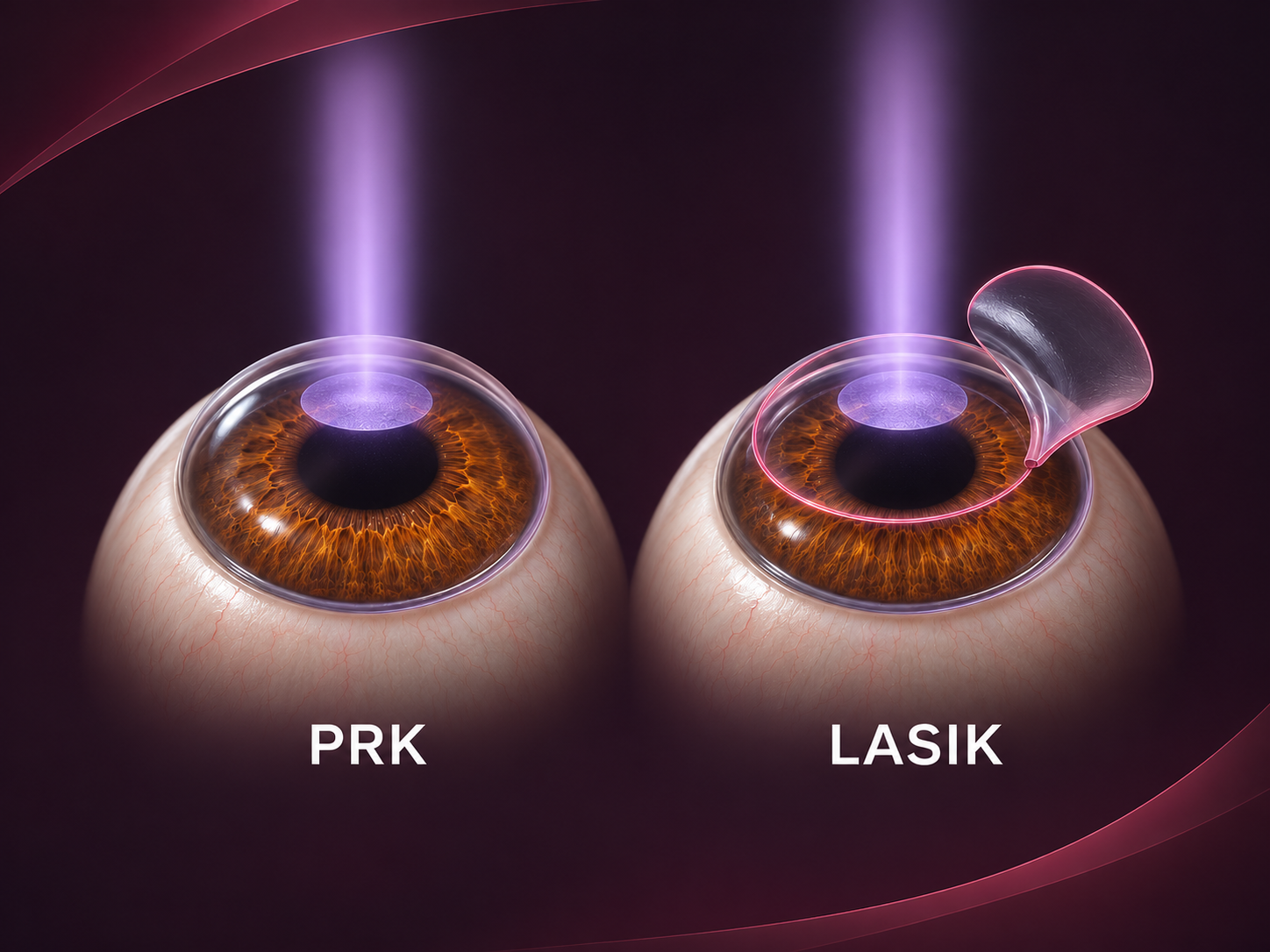
Imagine waking up, opening your eyes, and seeing the world clearly without reaching for your glasses. PRK makes this possible through a flapless laser procedure that reshapes the cornea to correct your vision.
Reviewed by: The Amanat Refractive Surgery Clinical Team
Lead Reviewer: Mr. Babar Sana, Chief Optometrist
What Vision Problems Can PRK Correct?
PRK can correct three common refractive errors:
- Nearsightedness (Myopia): When distant objects appear blurry.
- Farsightedness (Hyperopia): When nearby objects are difficult to see clearly.
- Astigmatism: When an irregularly shaped cornea causes blurred or distorted vision.
Who Might Benefit from PRK?
PRK may suit you if
- Certain corneal characteristics: Your scans may show features that make a flap less suitable.
- Contact sports or physically demanding work: With no flap, there’s nothing to displace.
Understanding the Anatomy: How Photorefractive Keratectomy Works
PRK corrects your vision by reshaping the cornea without creating a flap. The procedure uses an excimer laser to change how light enters your eye, helping it focus more accurately on the retina.
- Numbing the Eye
A comfortable start to treatment
Your surgeon applies anesthetic eye drops to numb the surface of your eye before the procedure.
- Removing the Epithelium
Preparing the cornea for laser treatment
The thin outer layer of your cornea, called the epithelium, is gently removed using a specialized instrument, brush, or laser.
- Laser Reshaping
Reshaping your cornea with an excimer laser
The laser removes microscopic amounts of tissue from the stroma, the thicker layer beneath the epithelium. This changes the shape of your cornea to correct your refractive error.
- Protecting the Eye
Supporting the healing process
A soft bandage contact lens is placed over your eye to protect the treated surface while the epithelium naturally grows back.
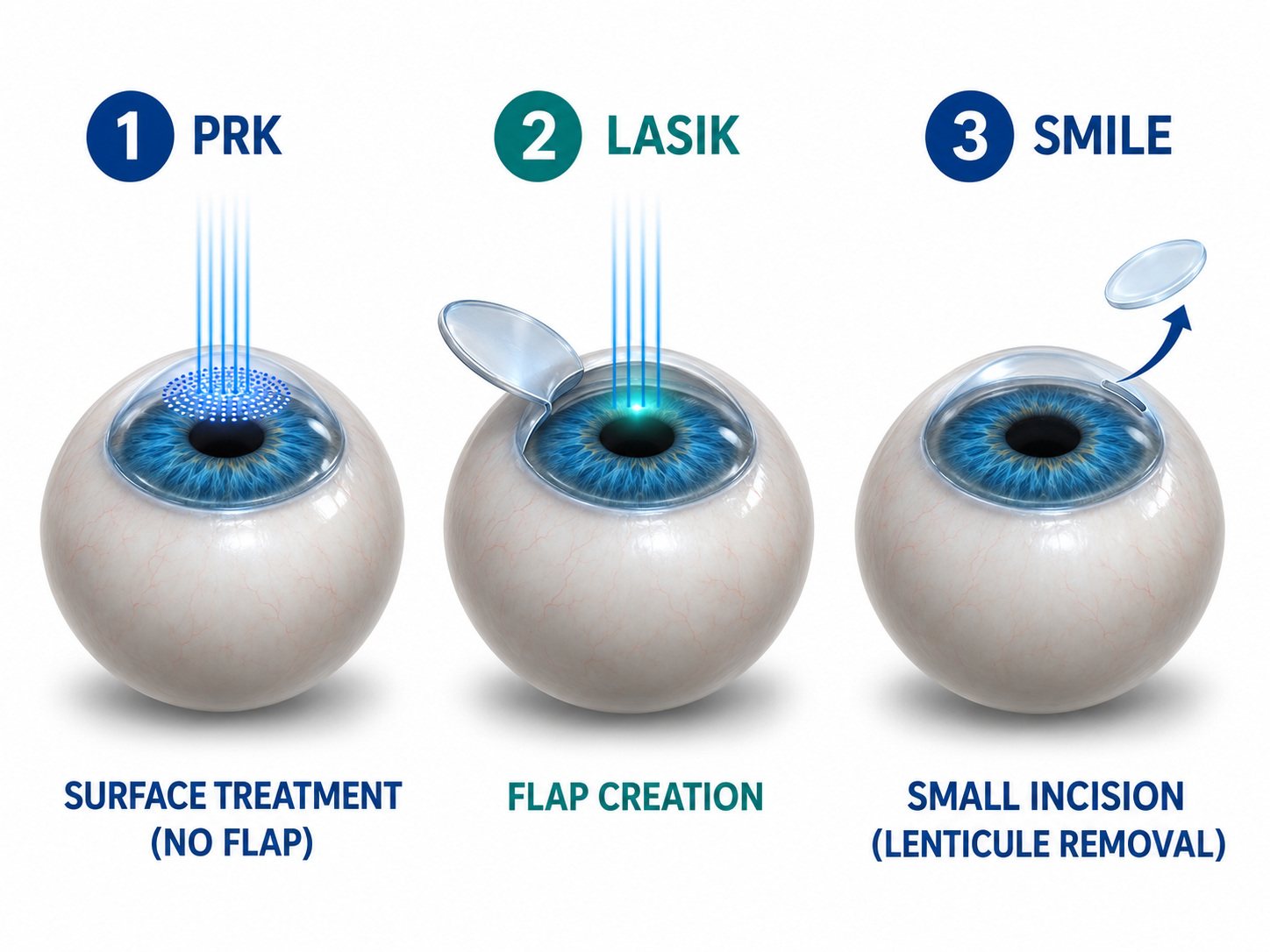
PRK vs. LASIK vs. SMILE: Which Is Right for You?
PRK, LASIK and SMILE are three types of laser vision correction designed to reduce dependence on glasses or contact lenses. While all three reshape the cornea to correct refractive errors, they differ in how the surgeon accesses the corneal tissue and how the eye heals afterwards.
PRK vs. LASIK vs. SMILE: A Side-by-Side Comparison
| Feature | PRK | LASIK | SMILE |
| Corneal flap | No | Yes | No |
| Treatment area | Corneal surface | Under a flap | Inside the cornea |
| Laser used | Excimer laser | Femtosecond + excimer laser (typically) | Femtosecond laser |
| Initial recovery | Slower | Fastest | Moderate |
| Early discomfort | More common | Usually mild | Usually mild |
| Common applications | Myopia, hyperopia and astigmatism | Myopia, hyperopia and astigmatism | Myopia and astigmatism |
| Flap-related complications | Not applicable | Low likelihood | Not applicable |
The Team and Technology
- Dr. Aamir Asrar: FCPS, FRCS, and Corneo-Refractive Surgery fellowship.
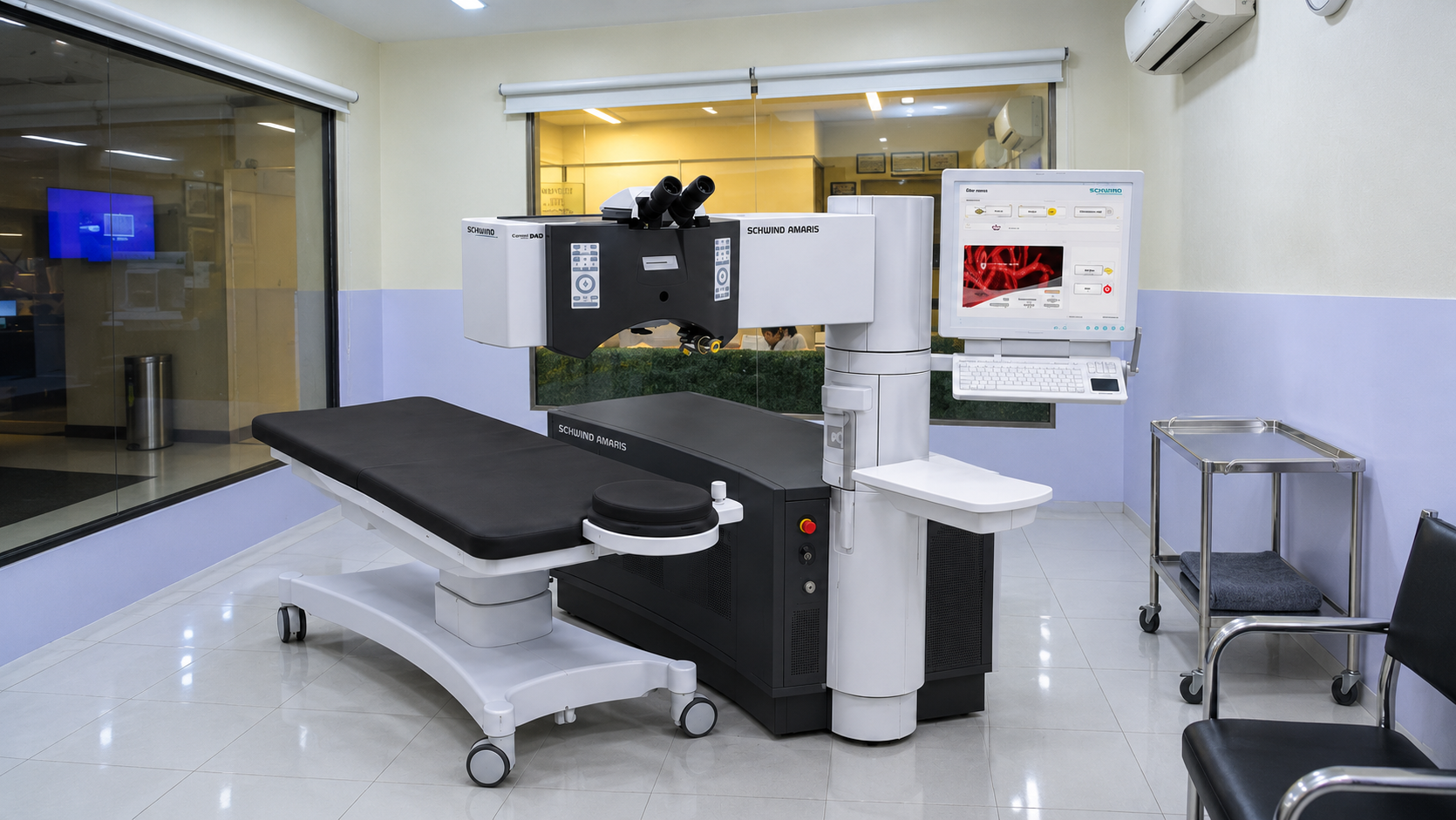
- Excimer laser: SCHWIND AMARIS® Special 1050RS limited edition
- Pre-operative assessment: Pentacam, Corvis ST, refraction, cycloplegic refraction, and fundoscopy.
PRK Eye Surgery Eligibility & Candidate Criteria
Not everyone is an immediate candidate for PRK. Your surgeon will assess your prescription, corneal thickness, and overall eye health during a pre-surgery examination.
Who Can Get PRK Eye Surgery?
- Age 18 or older
Your vision has had time to develop. Some surgeons prefer patients to be 21 or older. - Stable prescription
Your glasses prescription has remained unchanged for at least 12 months. - Treatable prescription
Your nearsightedness, farsightedness, or astigmatism falls within the laser’s safe treatment range. - Healthy corneas
Your corneal shape and thickness are suitable for laser treatment. - Healthy eyes
You do not have active eye infections or conditions that could interfere with healing.
Who Might Not Qualify for PRK Eye Surgery?
- Under 18
Your eyes are still developing. - Changing prescription
Your vision has changed within the last year. - Outside the treatable range
Your prescription requires more corneal tissue removal than is considered safe. - Keratoconus
These conditions can make laser vision correction unsafe. - Severe dry eye or certain health conditions
Autoimmune conditions and uncontrolled diabetes may affect healing. Pregnancy and breastfeeding may also require postponing surgery.
Diagnostic Tests Before PRK Surgery
Before recommending PRK, your surgeon will perform several tests to assess your eye health and determine whether laser treatment is suitable.
- Corneal Pachymetry: Measures corneal thickness to determine how much tissue is available for reshaping.
- Corneal Topography: Maps the shape and curvature of your cornea to identify irregularities such as keratoconus.
- Refraction Test: Measures your prescription, including nearsightedness, farsightedness and astigmatism.
- Tear Film Assessment: Checks for dryness and other surface conditions that could affect healing.
- Dilated Eye Examination: Allows your surgeon to examine the retina and other internal structures of your eye.
Find Out If PRK Is Right for Your Eyes?
PRK Recovery: What to Expect
PRK recovery takes longer than LASIK because the outer layer of the cornea needs time to regenerate. Most patients experience discomfort, light sensitivity, and blurry vision during the first 3 to 4 days.
- Days 1 to 7: A bandage contact lens protects the eye while the surface heals. It is usually removed around day 4 to 7.
- Weeks 1 to 4: Vision gradually improves, although some blurriness, dryness, and light sensitivity may continue.
- Months 1 to 6: Vision continues to sharpen and stabilize. Final results may take three to six months or longer.
When can you return to work? Most patients need around 3 to 7 days off, depending on their recovery and work routine. Avoid driving until your surgeon confirms your vision is safe.
Following your prescribed eye drops and attending follow-up appointments are important for proper healing. Contact your surgeon if you experience severe pain, sudden vision changes or increasing redness.
PRK Eye Surgery Cost in Pakistan and Next Steps
How much does PRK eye surgery cost?
The cost depends on your prescription and what your eye assessment shows. After your assessment, our team will give you a clear quote for your treatment.
How can I pay?
We offer flexible payment options, card payments, and bank transfers.
Is PRK covered by insurance?
Coverage depends on your policy and provider. Contact us, and our team will help you check.
Your next steps
- Book an assessment at your nearest Amanat Eye Hospital branch in Rawalpindi, Islamabad, Lahore or Peshawar.
- Have your corneal scans reviewed by Dr. Aamir Asrar.
- Receive a personal plan and a clear quote.
- Decide in your own time.
Frequently Asked Questions
How long should I take off work after PRK?
Many people return to work within about 3 to 7 days.
What if I work on a computer all day?
Screen-heavy work can be harder in the first week because of glare and eye fatigue. Vision can also fluctuate for the first few weeks, even after the surface has healed. Planning 7 to 10 days of rest can make recovery smoother.
Why is my vision blurry after PRK?
Blurriness comes from the new surface layer (epithelium) smoothing over the treated area. It usually improves gradually over the following weeks.
Should I compare my left and right eye while I recover?
It’s best not to. Healing rarely happens at the same pace in both eyes, so day-by-day comparisons can cause unnecessary worry while your brain adjusts to the new vision.
What is the bandage contact lens for?
The clear lens acts as a protective barrier for the delicate cells growing back on the surface of your eye.
What happens when the bandage lens is removed?
The period around removal can feel gritty for a short time, as the surface may be dry. Using your prescribed steroid and lubricating drops exactly as directed helps manage this and keeps the surface clean.
Why Is PRK Called a Flapless Procedure?
PRK works directly on the cornea’s surface without creating one. This means there is no risk of flap displacement, even after significant eye trauma years later.
Is corneal haze permanent after PRK?
Usually not. Mild haze, a temporary cloudiness on the surface of the cornea during healing, most often clears on its own within about 3 to 6 months.
Will I see halos around lights after PRK?
Some people notice halos or glare at night while the eye heals. They often improve as healing settles. If they are bothersome or don’t fade, tell your surgeon.
Can I have a touch-up if my vision changes years later?
Possibly. Vision can shift over time, including with natural ageing, and further treatment may be an option if your corneal health and thickness allow. Your surgeon will assess this individually.
Does PRK make a future touch-up easier?
In some cases, yes. Because PRK doesn’t cut a flap, it can leave more of the cornea’s natural tissue intact, which may give your surgeon more options for safe adjustments later.
Disclaimer: The information provided here is for educational purposes and does not replace professional medical advice. Always consult a certified ophthalmologist.